Close
|
|

|
|
While searching for information on advanced driver assistance systems (ADAS) on an OEM repair information site, you may come across unique calibration procedures or events. These events can vary by year and model, even within a particular make. As the RTS team has been researching these systems, we have been identifying these atypical circumstances. In order to help you better understand them, we are putting together a series of articles that help with the repair and calibration of ADAS. Let’s look at the Subaru Steering Responsive Headlight (SRH) system.

I-CAR and the I-CAR Repairability Technical Support (RTS) team put together a series of live webinars that discuss aspects of today’s advanced driver assistance systems (ADAS) and what the industry needs to know. These informative and fun webinars are sure to educate and entertain. In case you missed it; we put the video of the webinar on the RTS website for easy access.
Looking for more information about a specific repair procedure? Some OEMs are now providing videos within the repair procedures on their service site. Vehicle makers may also have additional websites that contain repair videos. As we research OEM websites and find these helpful videos, we will write articles to let you know. Let’s take a closer look at Kia.
When repairing a vehicle that has been involved in a collision, you may notice that there are damaged wires, connectors, and other components of the wiring harness. Some of the damaged wiring harnesses are considered non-SRS. As the RTS team researched non-SRS wiring repairability options from OEMs, we have compiled this information into a series of articles.
What is a non-SRS wiring repair? It is the repairing of an electrical component that is not part of the supplemental restraints system circuit (usually identified by yellow wire looms). As technology increases on vehicles, so does the number of components that utilize electricity. Many of the sensors and modules are becoming smarter and more sensitive. If the wire is too long, the wrong gauge, or spliced in the wrong location, it can cause malfunctions in the components that it’s powering. Many OEMs have different restrictions and guidelines for repairing wiring that does not control SRS components. On the other hand, there are OEMs that don’t allow wiring repairs at all, so full harness replacement is the only option. Let’s take a closer look at FCA/Stellantis.
Looking for more information about a specific repair procedure? Some OEMs are now providing videos within the repair procedures on their service site. Vehicle makers may also have additional websites that contain repair videos. As we research OEM websites and find these helpful videos, we will write articles to let you know. Let’s take a closer look at Honda/Acura.
A question often asked of the Repairability Technical Support (RTS) team is, "Can heat be used to straighten?" Several OEMs provide steel repairability matrices that provide heating times and temperature limits based on the type of metal being repaired, while other OEMs have restrictions on using heat at all. Let’s see what Ford/Lincoln has to say.
Repairer Driven News (RDN) released an article that focuses on rust under body filler. It discusses the reasons why rust can form under filler and offers solutions on how to prevent it from happening.

One of the top technical inquiries received at Ask I-CAR is, “Is there a sectioning or partial replacement procedure available?” To help answer this question, RTS has an OEM Partial Part Replacemet Search available. Here you will find information on if these procedures are available on a specific vehicle. Let’s take a closer look at the 2020 Kia Telluride.

While searching for information on advanced driver assistance systems (ADAS) on an OEM repair information site, you may come across unique calibration procedures or events. These events can vary by year and model, even within a particular make. As the RTS team has been researching these systems, we have been identifying these atypical circumstances. In order to help you better understand them, we are putting together a series of articles that help with the repair and calibration of ADAS. Let’s take a closer look at Toyota Safety Sense.
A question often asked of the Repairability Technical Support (RTS) team is, “Does an OEM allow the use of heat when straightening?” Several OEMs provide a steel repairability matrix that provides information on when use of heat is allowed. Many OEM’s also specify heating and temperature limits based on the type of metal being repaired. We’ve researched documentation on the use of heat during repairs and compiled the information into a series of OEM-specific articles.
A question often asked of the Repairability Technical Supports (RTS) team is, "Can heat be used to straighten?" Several OEMs provide steel repairability matrices that provide heating times and temperature limits based on the type of metal being repaired, while other OEMs have restrictions on using heat at all. Let’s see what General Motors (GM) has to say.

A spring edition of the General Motors (GM) Repair Insights magazine is now available.
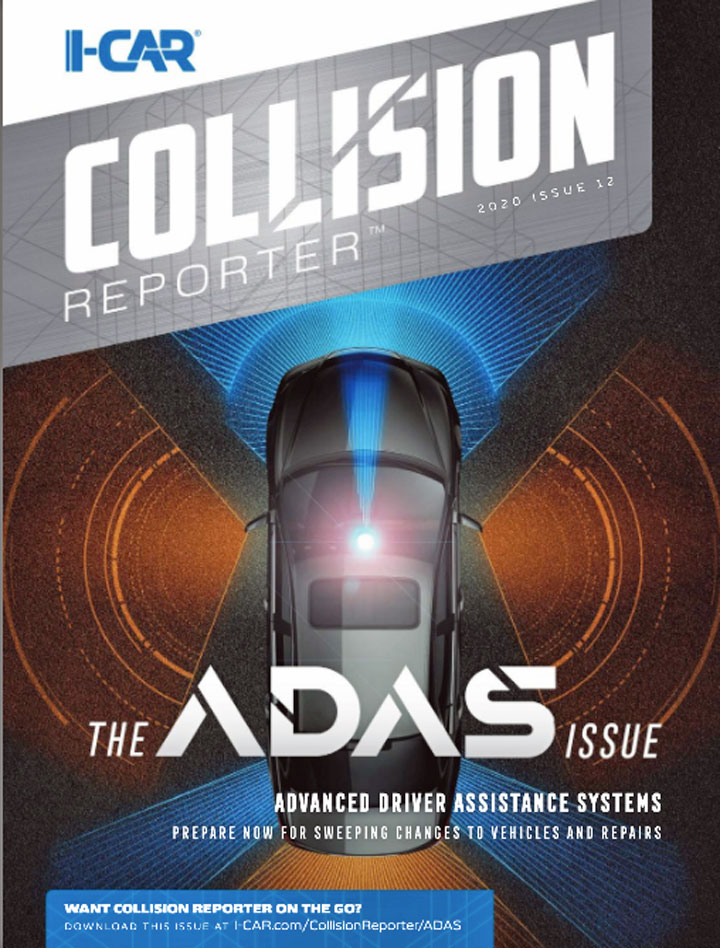
The twelfth installment of the I-CAR Collision Reporter - The ADAS Issue has been released. This issue focuses on the increasing number of ADAS equipped vehicles, and how ADAS has become an integral part of the collision industry that is here to stay.
Looking for more information about a specific repair procedure? Some OEMs are now providing videos within the repair procedures on their service site. Vehicle makers may also have additional websites that contain repair videos. As we research OEM websites and find these helpful videos, we will write articles to let you know. Let’s take a closer look at FCA/Stellantis.